Senteon Takes Top Honors in 2026 Top InfoSec Innovator Awards
Senteon wins Best Solution Patch and Configuration Management in Cyber Defense Magazine's 2026 Top InfoSec Innovator Awards.
4 min read
Henry Zhang
:
Published
Secure now, secure for good.
For any organization gearing up for a SOC 2 Type II audit, locking down their endpoint configurations is a crucial first step. But what about after that baseline is set? The real challenge starts when the updates come in and the changes take hold.
Think about it: your operating systems get updated, your IT folks troubleshoot the odd issue, software gets installed, or those 'necessary' exceptions get added. Over time, all these minor adjustments can slowly start to drift you away from the security settings you originally set up.
And let's not forget: by the time the auditors come knocking, you need to be able to prove that your systems have been properly configured and that your security controls have been working as they should all along. A single snapshot of your system on a particular day won't be enough to cut it.
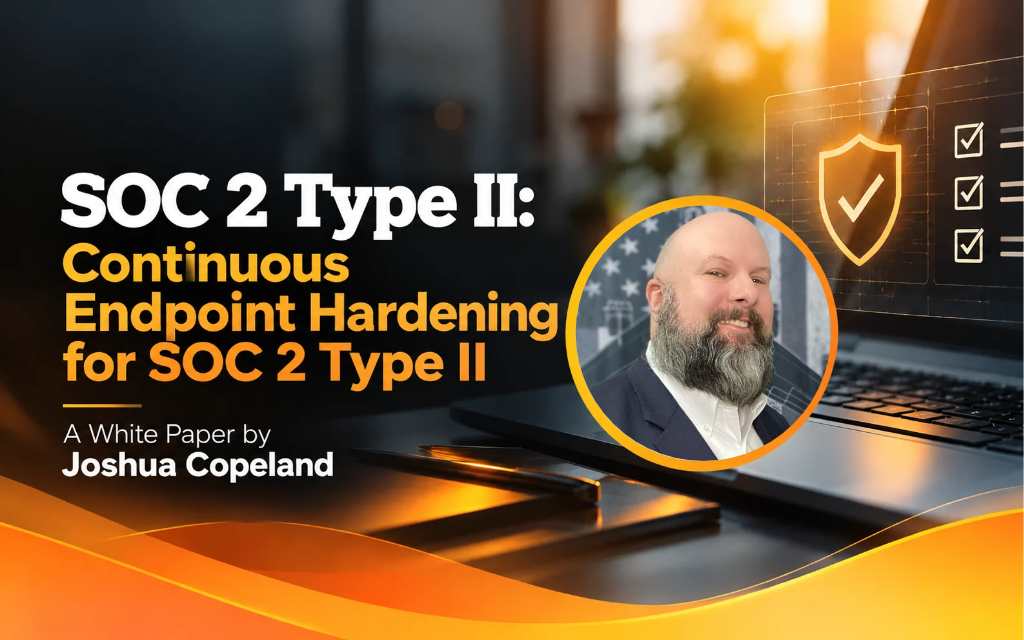
That's exactly the gap that Joshua Copeland's white paper, Continuous Endpoint Hardening for SOC 2 Type II, aims to address. He lays out a roadmap for companies to continuously monitor, fix and document their endpoint settings to give them the evidence they need to show that their security controls have been working throughout the audit period.
SOC 2 Type I audits look at a company's controls on one specific day. SOC 2 Type II goes a step further and checks whether those controls actually worked throughout a set period.
This matters when it comes to endpoint security. You might be able to show that you set up a secure configuration on your workstations and servers but if those settings get changed a few weeks later without you realizing and don't get sorted out, then all that original effort is pretty much wasted.
So what's the alternative?
In this case, it's to transform endpoint hardening from a one-off project into a repeatable and ongoing process. This means regularly checking that your settings are still up to scratch, following up on any changes that get flagged and keeping a record of all your activity.
Configuration drift occurs when your actual endpoint settings diverge from the version you originally set up.
These changes aren't always deliberate or malicious. More often than not, they're the result of perfectly normal IT activities like software updates, troubleshooting or minor adjustments from the IT team.
However, these little changes can add up and have serious implications for your security posture.
For instance, changes to your configuration can affect password requirements, remote access rules, firewall settings, file-sharing permissions, audit policies and antivirus configurations.
If you're not keeping track of these changes, then you might not even realize they've happened until it's time for a security assessment or audit.
And when it comes to SOC 2 Type II, it's not just about spotting when drift has occurred, it's about showing that you've been monitoring for changes, checking that they're okay and fixing them when they're not.
Senteon can help organizations turn endpoint hardening into a consistent process rather than a one-off task.
Here's what we can do:
Organizations can create a target configuration for different groups of endpoints, giving them a clear standard to work with.
Senteon keeps an eye on your endpoint settings and checks them against your target configuration to help teams spot any discrepancies.
Senteon has automated and manual tools to get your settings back on track, reducing the time spent on repetitive manual remediation.
Senteon helps keep a log of your setting history, configuration reports, exception documentation and endpoint status information, making it easier to keep a record of how your security configurations have been maintained over time.
These features support an organization's overall SOC 2 control environment.
Joshua's white paper shows how Senteon's capabilities map to the relevant SOC 2 Trust Services Criteria.
The strongest alignment is with CC7.1, which deals with detecting and tracking vulnerabilities and configuration changes that might affect security.
Senteon also provides evidence to support other important criteria, including
These capabilities complement an organization's existing security tools, policies and procedures.
But it's worth noting that Senteon is not a replacement for other security controls, such as identity management, security event investigation, enterprise change approval or other controls required for a complete SOC 2 program.
One of the key takeaways is that a compliance report alone is not enough to prove continuous control effectiveness.
You'll also need to show that the right endpoints were covered, that monitoring was in place throughout the audit period and that any changes that got flagged were handled.
This involves keeping records of approved baselines, endpoint inventory, configuration history, drift events, remediation activity, exceptions and periodic management reviews.
Senteon can help provide the evidence you need to make it all easier to document and that’s helpful for Managed Service Providers supporting SOC 2 clients who need to standardize their configuration management and evidence collection across all customer environments.
Endpoint hardening is a job that doesn't stop when the baseline is set.To keep systems running smoothly, organizations need to constantly keep track of what's not changing, spot where new developments are happening, deal with any divergences from the norm and show that their security controls are still working over time.
Joshua Copeland's white paper, Continuous Endpoint Hardening for SOC 2 Type II, actually takes a much closer look at that whole process.
The paper is filled with SOC 2 control mappings, evidence of things like this you'll need to be able to show, some examples of statements that control compliance might look like in practice, plus some really useful guidance on how to implement continuous endpoint hardening in real organizations that are looking to improve their endpoint security setup.
Download the SOC 2 Type II White Paper to see in more detail how continuous hardening endpoint security can help your organization be SOC 2 ready.
Ready to see Senteon in Action? Let's get you set up with a free demo.
Senteon wins Best Solution Patch and Configuration Management in Cyber Defense Magazine's 2026 Top InfoSec Innovator Awards.
Discover why Microsoft Intune and Senteon work better together. Learn how continuous endpoint hardening closes security gaps and prevents...
Senteon and SPECTRA are partnering to connect continuous endpoint hardening with verified cyber resilience and stronger outcomes for MSPs.